Science491

OLCF science articles.

ScienceTechnology

Firing Up Quantum Fidelity

Researchers used the Quantum Computing User Program (QCUP) at the US Department of Energy's (DOE's) Oak Ridge National Laboratory (ORNL) to achieve major improvements in quantum fidelity, a potential step toward more accurate, reliable quantum networks and supercomputers. Quantum computing relies on transfer and storage of information via quantum bits,…
Matt Lakin
January 7, 2022
ScienceTechnology

Thinking outside the Black Box

A study led by scientists at the US Department of Energy's (DOE's) Oak Ridge National Laboratory (ORNL) plumbs the depths of deep learning and could connect the digital synapses toward better, more reliable artificial-intelligence (AI) models. The research team from ORNL and the National Energy Technology Laboratory used Summit, the…
Matt Lakin
January 6, 2022
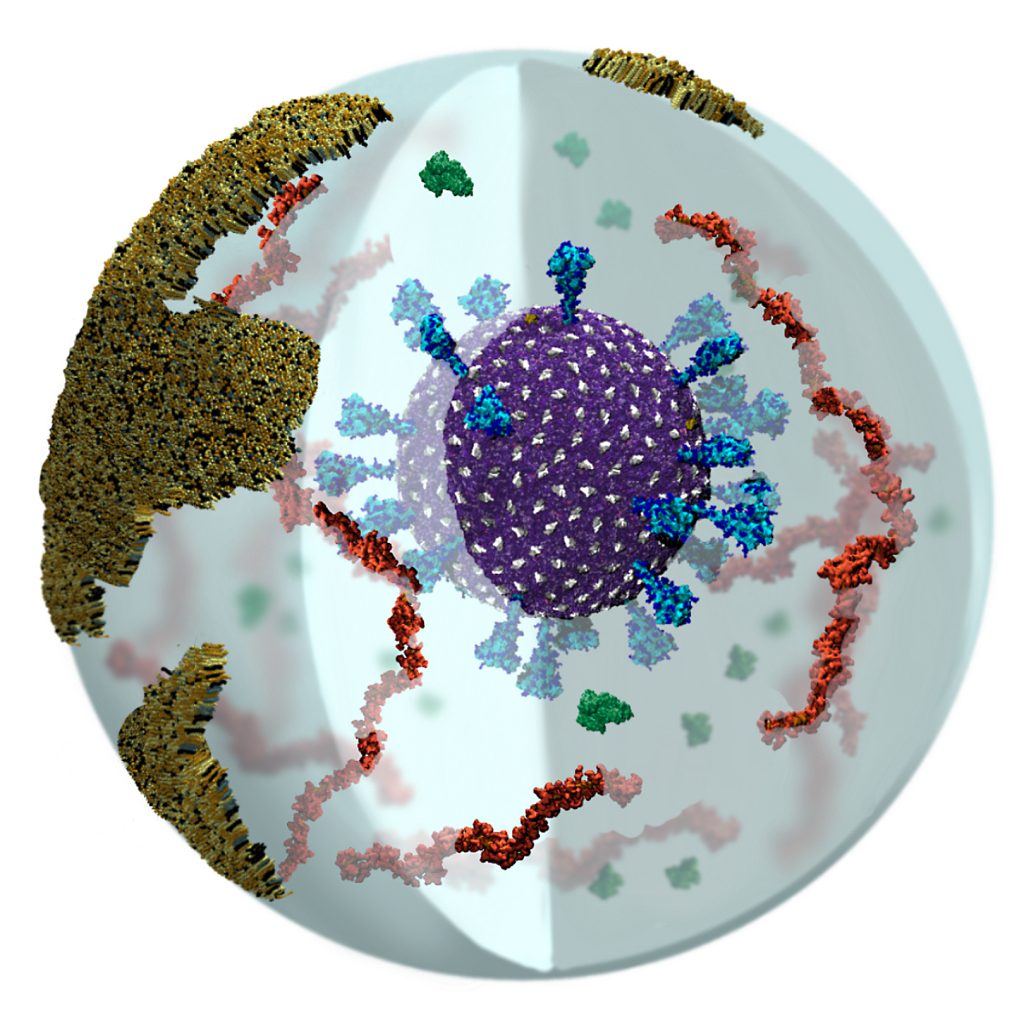
Visualization of an aerosolized SARS-CoV-2 particle with various components inside and outside the particle.Science

2021 at the OLCF: Year in Review

In 2021, supercomputing at the US Department of Energy's (DOE's) Oak Ridge National Laboratory (ORNL) enabled new scientific breakthroughs amid the global pandemic. From modeling small particles called quarks to simulating turbulence in fusion reactors, the Oak Ridge Leadership Computing Facility's (OLCF's) flagship supercomputer, Summit, continued to provide unprecedented opportunities…
Rachel McDowell
December 30, 2021
Science

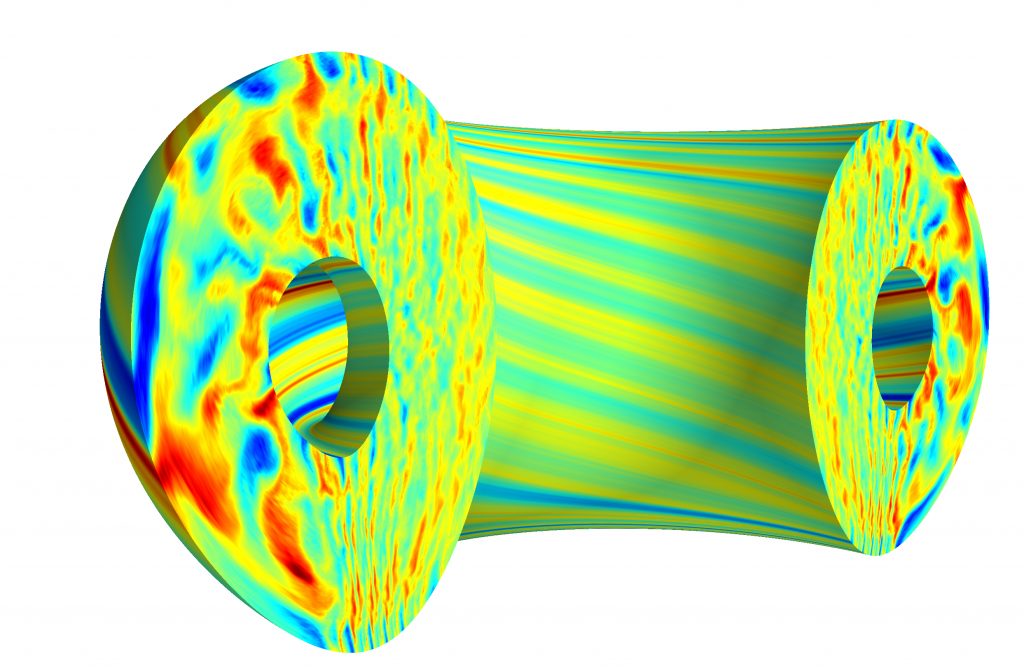
Closing In on Fusion

The same process that fuels stars could one day be used to generate massive amounts of power here on Earth. Nuclear fusion—in which atomic nuclei fuse to form heavier nuclei and release energy in the process—promises to be a long-term, sustainable, and safe form of energy. But scientists are still trying to fine-tune the process of…
Rachel McDowell
December 13, 2021
An image depicting a shock wave propagating through diamondScience

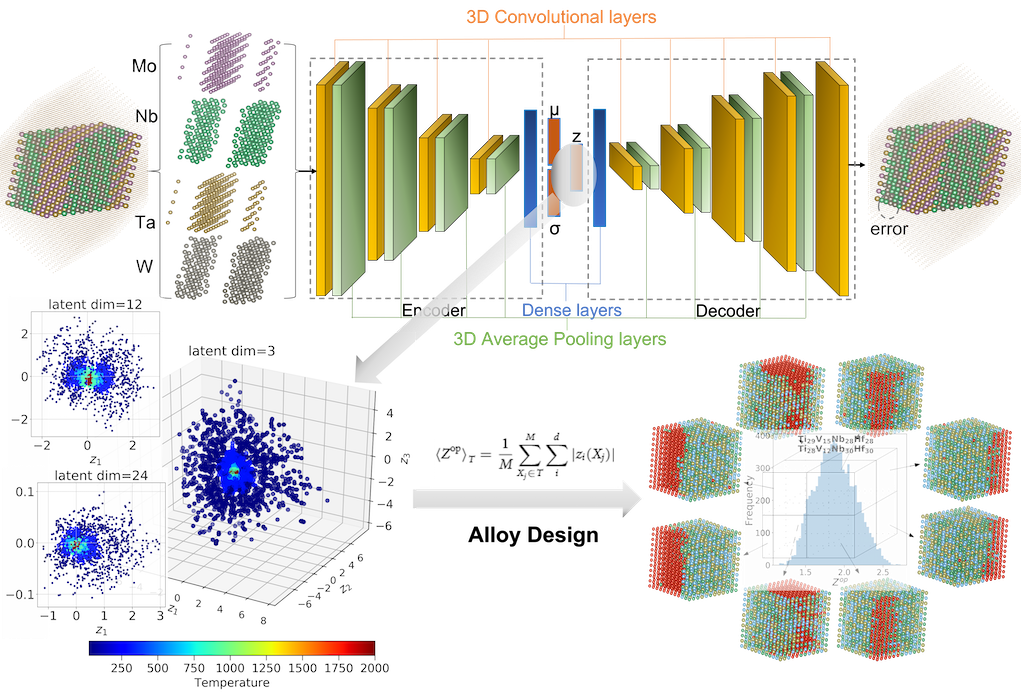
Team Earns Gordon Bell Prize Finalist Nomination for Simulating Carbon at Extreme Pressures and Temperatures

Are diamonds even stronger than we’ve ever imagined? Can other post-diamond phases appear when diamond is subjected to extreme pressures? A team used machine-learned descriptions of interatomic interactions on the 200-petaflop Summit supercomputer at the US Department of Energy’s (DOE’s) Oak Ridge National Laboratory (ORNL) to model more than a…
Rachel McDowell
November 17, 2021
Science

Unraveling the “Big Boom”

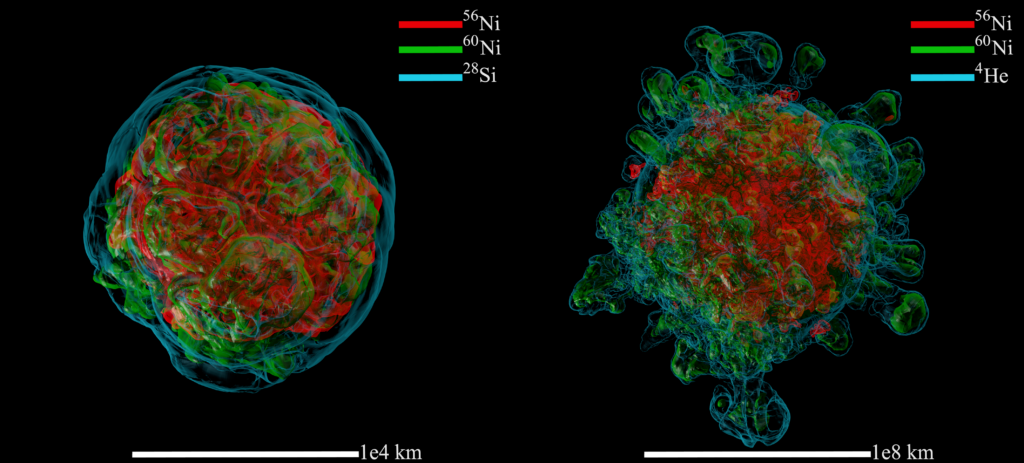
Simulations performed on Oak Ridge National Laboratory’s Summit supercomputer provide a more detailed look at how stars die and could help unlock new insights into the origins of Earth’s heavy elements. The study, conducted by scientists at ORNL and the University of Tennessee, Knoxville, modeled the collapse and explosion of…
Matt Lakin
November 11, 2021
exascale obstaclesScienceTechnology

Exascale Computing’s Four Biggest Challenges and How They Were Overcome

In 2008, the Exascale Study Group (ESG) issued a report, Technology Challenges in Achieving Exascale Systems, sponsored by the Defense Advanced Research Projects Agency. It concluded that exascale supercomputers faced four major obstacles—power consumption, data movement, fault tolerance, and extreme parallelism—“where current technology trends are simply insufficient, and significant new…
Coury Turczyn
October 18, 2021
Frontier: the Direction of DiscoveryScience

Exascale Day 2021

On October 18, the US Department of Energy’s (DOE’s) Oak Ridge National Laboratory (ORNL) is celebrating the third National Exascale Day. The holiday was created in 2019 as an initiative of DOE’s Exascale Computing Project (ECP) and Cray, a Hewlett Packard Enterprise Company, to honor scientists and researchers who will make…
Katie Bethea
October 18, 2021
Science

Reaching Remarkable States of Matter with Laser Simulations

With the help of supercomputers, scientists are getting a better idea of how to study some of the strongest electromagnetic fields in the universe. Scientists aim to use high-power lasers to blast different materials and study the interplay between light and matter. Quantum electrodynamics (QED) is the study of how…
Rachel McDowell
September 10, 2021
Science

Shape-Based Model Sheds Light on Simplified Protein Binding

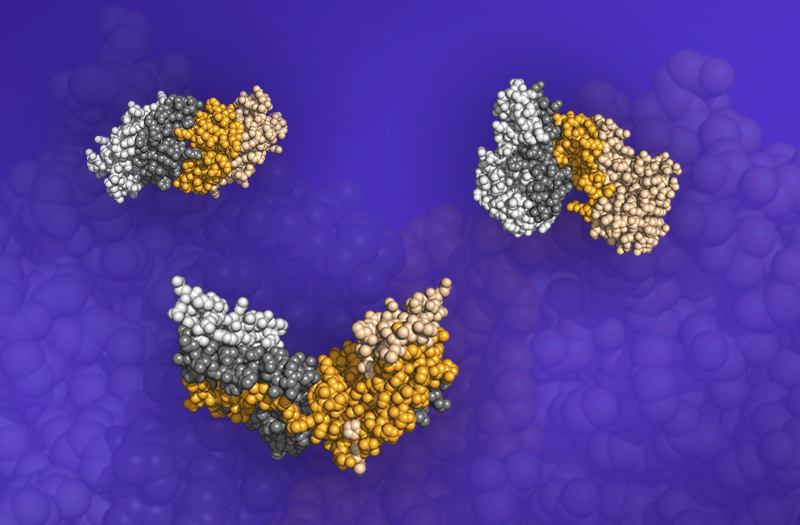
Can something as simple as shape fully determine whether or not proteins will bind together? Scientists are commissioning supercomputers to find out. A team led by Sharon Glotzer, distinguished professor and department chair of chemical engineering at the University of Michigan (UM), used the 200-petaflop Summit supercomputer at the US…
Rachel McDowell
August 9, 2021
Science

Titan Study Takes Jet Turbine Design to New Heights

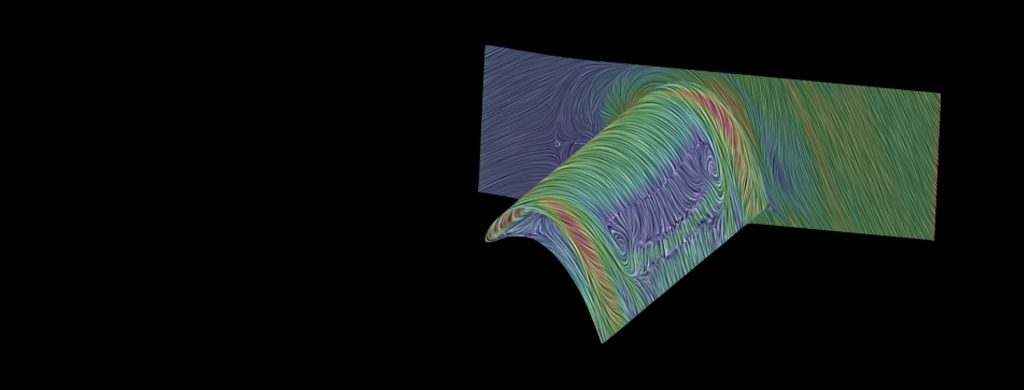
Simulations performed on Oak Ridge National Laboratory’s (ORNL’s) Titan supercomputer could clear the runway for more efficient jet-engine turbines and help set a new benchmark for turbine design. The study by an international team of scientists modeled air flow over a 3D turbine blade using the computational power of Titan,…
Matt Lakin
July 22, 2021
ALCC program banner with 4 bubbles showing images of medical records, clouds, the Spallation Neutron Source target, and wind farmsScience

ALCC Program Announces 2021–2022 OLCF Research Grants

The US Department of Energy’s (DOE’s) Office of Advanced Scientific Computing Research (ASCR) is tasked with leading the world in supercomputing, high-end computational science, and advanced networking for science. One of its most important tools in advancing computational science is the annual ASCR Leadership Computing Challenge (ALCC). The competitive program…
Coury Turczyn
July 2, 2021