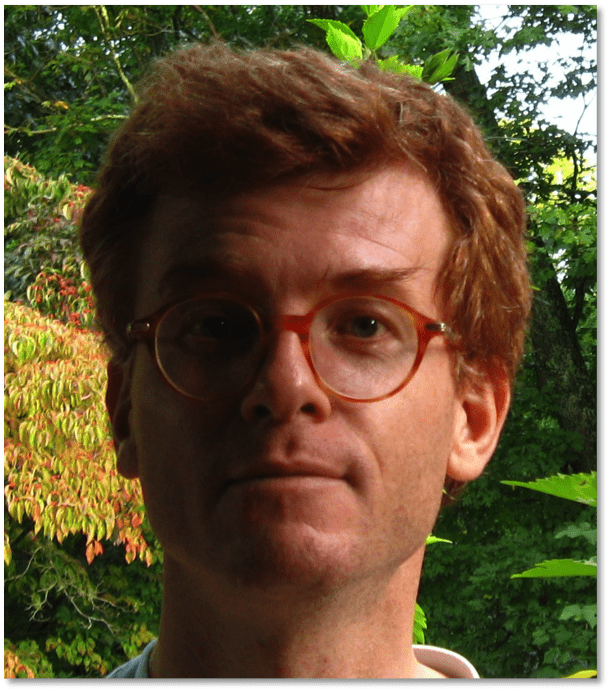
The Oak Ridge Leadership Computing Facility (OLCF) hasannounced that Jack Wells will take over as the organization’s new Director of Science effective July 1, 2011.

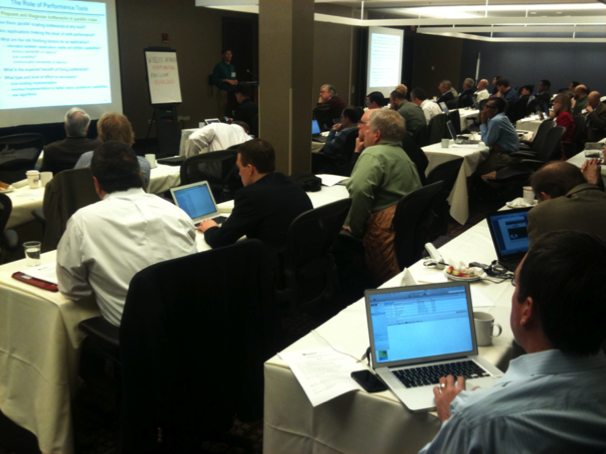
Members of the OLCF staff joined high-performance computing professionals from around the U.S. for the 2011 Cray User Group (CUG) meeting held in Fairbanks, AK, May 23-26.
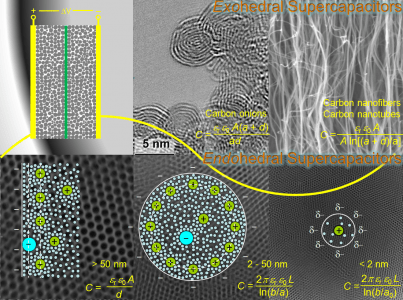
Discovery boosts supercapacitor energy storage Computational modeling of carbon supercapacitors with the effects of surface curvature included.—Image credit: Jingsong Huang, ORNL Flat is in the eye of the beholder. When you’re talking about nanomaterials, however, that eye is pretty much useless unless it’s looking through an electron microscope or at…
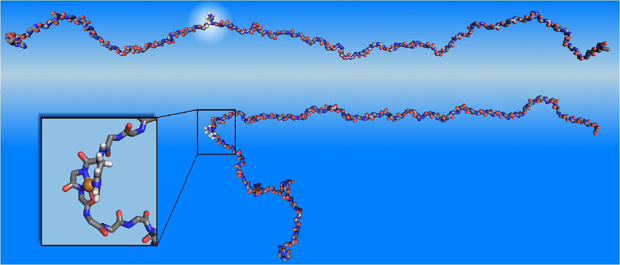
Calculations on the Jaguar supercomputer reveal metal binding likely to misfold alpha-synuclein Alpha-synuclein, a protein that misfolds in Parkinson's disease, is shown in its free state (top) and bound to copper (bottom). Copper binding, detailed in the boxed area, accelerates the protein's misfolding. Image credit: Frisco Rose, Miroslav Hodak, and…
Chemistry and materials science simulations made possible through Robert Harrison’s INCITE project have generated 70 scientific publications since 2008.
On April 13, the U.S. Department of Energy announced that proposals are now being accepted for the Innovative and Novel Computational Impact on Theory and Experiment (INCITE) program, which supports high-impact scientific advances through the use of the DOE Leadership Computing Facilities located at Oak Ridge and Argonne National Laboratories.…
Through the ASCR Leadership Computing Challenge (ALCC), allocations were awarded to five projects with an emphasis on high-risk, high-impact research related to DOE’s energy mission. They are already providing insight into important efforts such as advancing the clean-energy agenda and understanding the Earth’s climate.
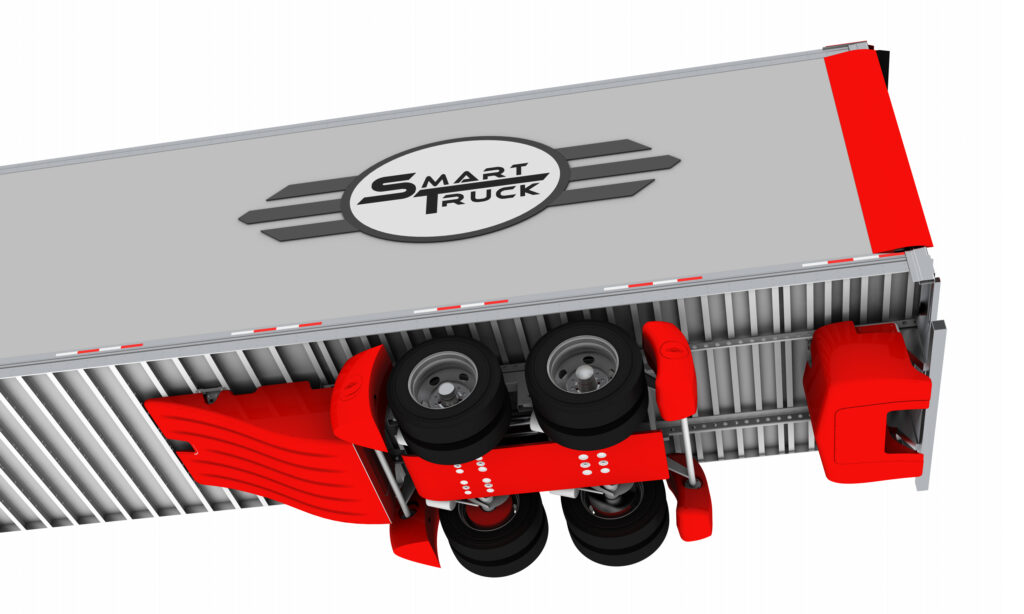
BMI Corporation is combining their aerospace and race care design expertise with the power of the OLCF’s Jaguar supercomputer to create a new, long haul “SmartTruck” that will increase fuel efficiency and reduce carbon emissions.
The Electronic Simulation Monitoring (eSiMon) Dashboard version 1.0 was recently released to the public, allowing scientists to monitor and analyze their simulations in real-time.
The publishers of the online supercomputing magazine HPCwire expect great things of ORNL computational chemist Edoardo Aprà in the coming year. Aprà is among 10 individuals included in the magazine’s “People to Watch” list for 2011.
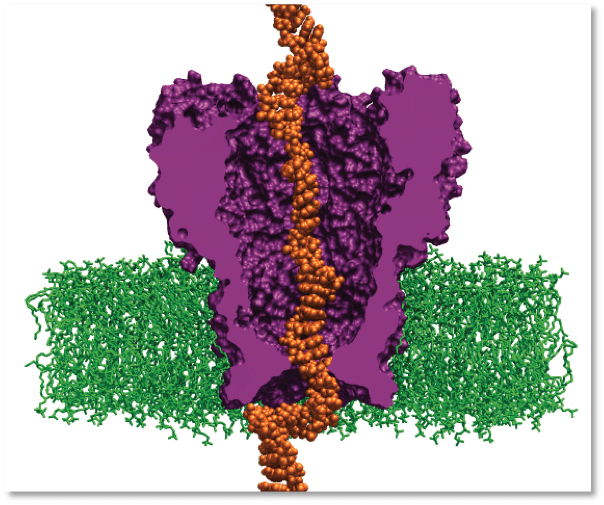
Using Jaguar, a research team led by Aleksei Aksimentiev, assistant professor in the physics department at the University of Illinois–Urbana-Champaign, began a project to create machines for personal genome sequencing that will be more accessible to hospitals.
Using Jaguar, SEACISM’s aim is to use state-of-the-art simulation to predict the behavior of ice sheets under a changing climate by developing scalable algorithms.
Users of ORNL’s Cray XT5 supercomputers will get an opportunity to hone their supercomputing skills this March at a weeklong “Spring Training” planned at ORNL.