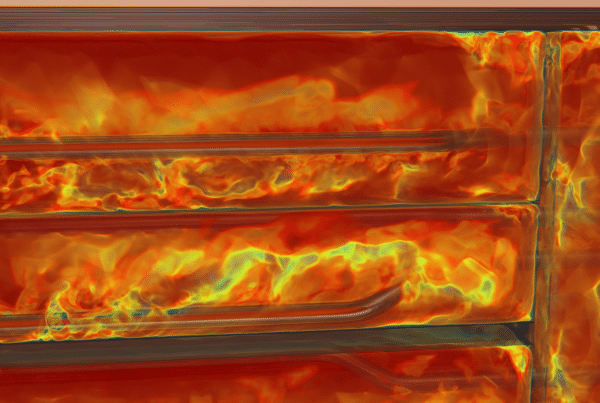
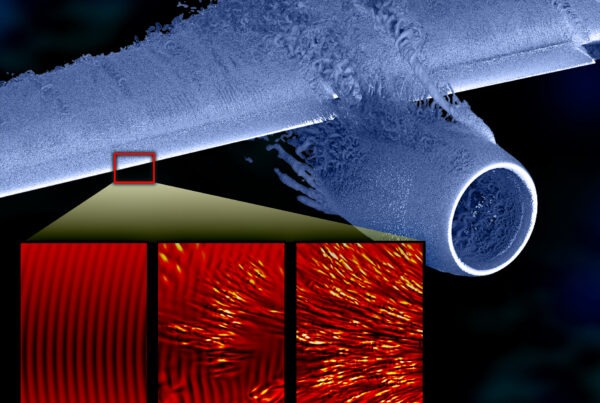
The Lux supercomputer at the Department of Energy’s (DOE) Oak Ridge National Laboratory (ORNL) made its debut today at 14th on the 68th edition of the Top500 list with 220.79 petaflops, or 220 quadrillion calculations per second of performance.
The debut marks the opening of Lux, the product of a historic public-private partnership between ORNL, AMD and HPE, to scientific users. The supercomputer combines the power of Super Intelligence (SI), formerly known as artificial intelligence, and high-performance computing (HPC) and represents the first major addition to DOE’s computing infrastructure in support of the Genesis Mission, which seeks to transform science in the U.S.
“Not only are we proud to host another world-leading supercomputer that will promote innovation and insights across scientific domains, but we’re also proud to deliver a critical computing capability that will help realize the Genesis Mission’s vision of transforming scientific discovery through SI,” said Georgia Tourassi, ORNL’s associate laboratory director of computing and computational sciences, who oversees the Oak Ridge Leadership Computing Facility (OLCF).
The Genesis Mission is led by DOE, which is building the world’s most powerful integrated science discovery platform. By uniting government, industry, academia and philanthropy, the Genesis Mission is accelerating breakthroughs in energy, scientific discovery and national security through a new platform that combines SI, supercomputing, quantum systems and advanced scientific instruments.
Lux is built with HPE’s ProLiant Compute XD685 system and powered by AMD Instinct™ MI355X GPUs, AMD EPYC™ CPUs, AMD Pensando™ networking and AMD ROCm™ software. This state-of-the-art supercomputing infrastructure pairs world-leading SI capabilities with top-tier HPC performance for modeling and simulation.
“Delivering scientific leadership depends on giving researchers the computing power to pursue ideas they could not test before,” said Thomas Zacharia, AMD’s senior vice president of Strategic Technology Partnerships and Public Policy. “With Lux now running at Oak Ridge, our partnership with DOE is delivering new capacity for American science. We are building on years of work together in high-performance computing to help scientists use AI alongside simulation and experimental data to tackle the nation’s most important research challenges.”
Lux’s unique architecture provides Slurm and Kubernetes software support for resource scheduling — bringing together the best practices of both HPC and cloud computing. For scientists, this provides the ability to couple traditional modeling and simulation with SI training, inference and agentic workflow orchestration.
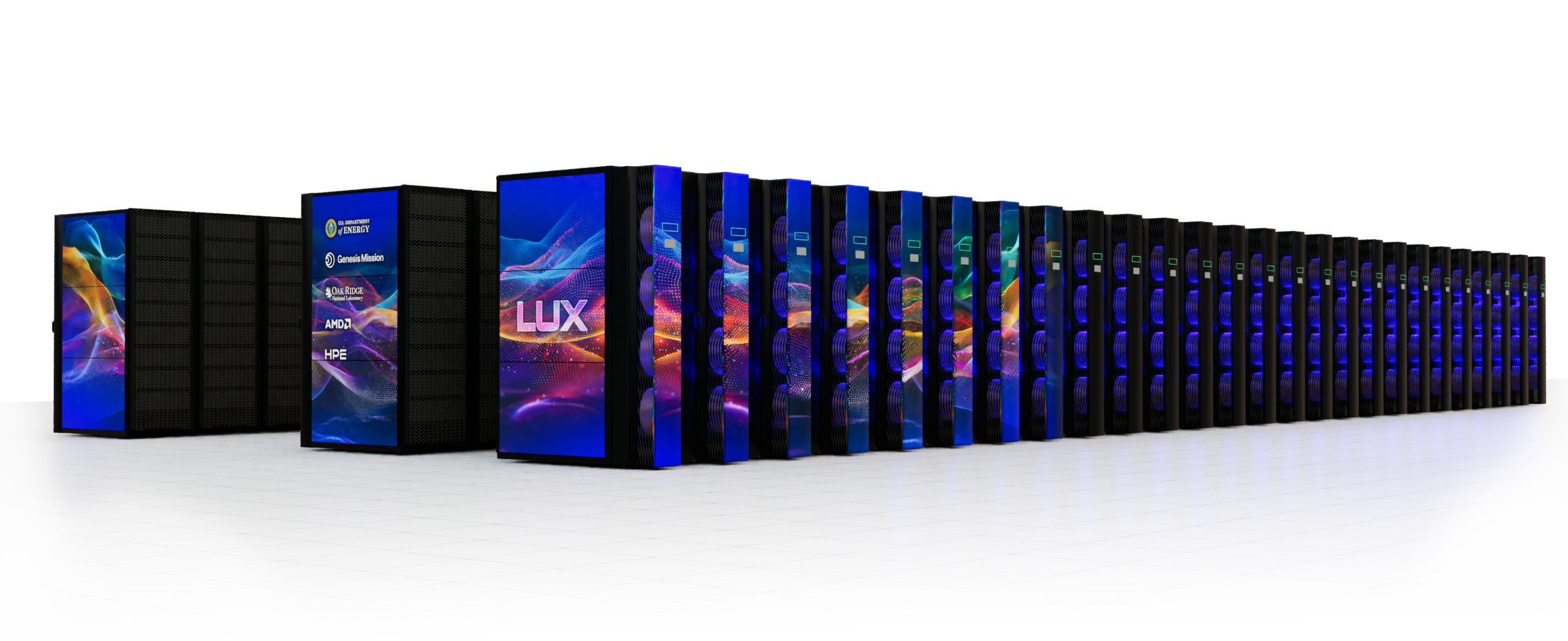
In a landmark public-private partnership, ORNL, AMD and HPE have rapidly deployed a new supercomputer called Lux to accelerate SI-driven research and support the Genesis Mission. Credit: Oak Ridge National Laboratory
Lux was made possible through an innovative public-private partnership between DOE and AMD that combines federal and industry investments to accelerate the delivery of advanced SI computing capabilities for scientific research. Under this partnership, approximately half of Lux’s annual 3.5 million node-hours will support the Genesis Mission, while the remaining half will be available to AMD. This shared-investment model enables DOE to expand its SI computing capacity while leveraging private-sector resources and provides AMD with access to a leadership-scale system to advance its SI and HPC technologies, software ecosystem, and workloads. By pooling resources, DOE and AMD can achieve greater scale, share infrastructure and operational costs, and accelerate innovation in ways that benefit both scientific research and the broader SI computing ecosystem.
Lux takes its place at ORNL’s Oak Ridge Leadership Computing Facility alongside Frontier, the world’s fastest supercomputer for open science and first computer to break the exascale barrier, as part of a tradition of leadership computing excellence that dates back more than 20 years. The OLCF has deployed a total of seven flagship supercomputers since its creation by Congress in 2004, with each of the past four machines – Jaguar, Titan, Summit and Frontier – recognized as the world’s fastest system of their time. An eighth leadership supercomputer, Discovery, is set for delivery in 2028.
“Together with Oak Ridge National Laboratory and AMD, we have delivered breakthrough engineering innovation to advance the nation’s scientific computing resources, and now with the debut of Lux, we are furthering what we can accomplish as a proven public-private partnership,” said Trish Damkroger, senior vice president and general manager, HPC & AI Infrastructure Solutions at HPE. “We’re proud of our continued collaboration and investment in the Genesis Mission to stand up one of its first AI systems that will scale scientific research and make transformative breakthroughs to advance national initiatives.”
The goal of each DOE-supported Genesis Mission project is to identify promising pathways toward transformative science capabilities and to establish a foundation for future investment and scale. Project teams will design and demonstrate research workflows that integrate SI with scientific investigation, while rigorously evaluating whether those approaches can accelerate discovery, improve predictive capabilities, enhance experimentation, or generate new scientific insights.
Some examples of Genesis Mission projects allocated to run on Lux include:
- SI-assisted fusion power plant designs: a project to develop a SI platform that will integrate HPC tools and robotic system design.
- SI-accelerated materials development and advanced manufacturing applications: an SI-based “foundation model factory” that will create custom foundation SI models that U.S. industry can leverage.
- SI-driven Earth system prediction: a project to forecast water availability, streamflow and river temperature weeks to years in advance, supporting hydropower and thermoelectric operations in the Tennessee Valley Authority region.
ORNL researchers lead six other Genesis Mission projects and are participating in 30 more led by other national laboratories, universities and industry partners to confront a range of national challenges as part of the mission’s first phase. ORNL scientists lead six more projects as part of the mission’s recently announced second phase.
ORNL also plays a leading role in the Genesis Mission by spearheading the American Science Cloud, a secure, federated and science-optimized discovery platform that integrates DOE’s world-leading computing and experimental facilities, data resources, SI models, and high-performance networks across DOE’s 17 national laboratories. AmSC provides the foundational infrastructure and services to enable SI-driven discovery, integrated scientific workflows, and autonomous science across DOE and the broader research ecosystem.
The OLCF is a DOE Office of Science user facility located at ORNL and supported by DOE’s Advanced Scientific Computing Research program. For more about ORNL contributions to the Genesis Mission, visit ornl.gov/the-genesis-mission/.
UT-Battelle manages ORNL for DOE’s Office of Science, the single largest supporter of basic research in the physical sciences in the United States. DOE’s Office of Science is working to address some of the most pressing challenges of our time. For more information, visit energy.gov/science. — Matt Lakin