ORNL’s Oak Ridge Leadership Computing Facility (OLCF) is introducing the AMD Lux AI+HPC supercomputer to enable its users to dramatically accelerate AI- driven research. OLCF brings a rich history of deploying and operating leadership supercomputers since 2004 including the first supercomputer to use GPUs at scale (Titan in 2012), the first to use HBM and NVLINK (Summit in 2018), and the first to achieve 1 ExaFLOP in FP64 performance (Frontier in 2022).
In a unique public-private partnership model, AMD is co-investing with DOE to deliver Lux. AMD brings world-leading X86 CPU performance and unmatched GPU memory capacity and bandwidth, offering excellent AI and HPC (modeling and simulation) performance.
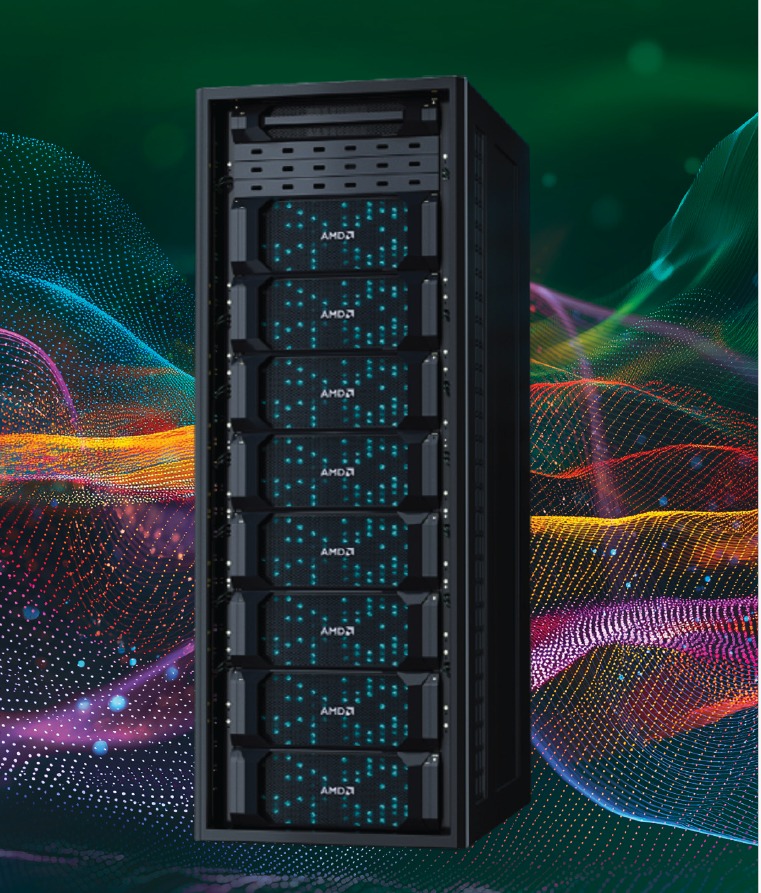
The AMD Lux AI Cluster, will be deployed at ORNL within the next six months to expand DOE’s near-term AI capacity and accelerate progress on critical problems. Credit: AMD and ORNL
Built for AI and HPC
Lux will have AMD’s MI355X GPUs with 288 GB of HBM3E with 8 TB/s of bandwidth. The MI355X provides 5 PF of AI training (FP8) performance and 78 TF of HPC (modeling and simulation using FP64) performance.
Lux will have both Slurm and Kubernetes support for resource scheduling. The size of the partitions will depend on demand and will adjust over time.
Storage is Included
While each node has over 24 TB of NVMe SSDs for high performance reading and writing, Lux allocations also will include access to OLCF’s Lustre file system, Orion, with over 600 PB of capacity. And Lux partners with Frontier allocations can create data sets written from Frontier to Orion and then train on those data sets on Lux.
DOE Moderate Security Controls
Lux will use DOE Moderate controls, the same level of security controls as OLCF’s leadership system, Frontier. DOE Moderate controls allow for export-controlled applications and data. OLCF plans to add support for DOE Moderate- Enhanced controls. When available, this would also enable support for International Traffic in Arms Regulations (ITAR) and Protected Health Information (PHI) applications and data.
Flexible Allocation Dates

Half of Lux’s annual 3.5 million node-hours are dedicated to the Genesis Mission to accelerate scientific discovery, with the remaining half available for proprietary (paid for) use under the DOE User Facility rate. Proprietary projects can begin in any month and run from six months to five years.