Nuclear power is rising to meet the demand for American energy. But building new reactors or even renewing licenses of existing ones requires a tremendous amount of paperwork. Fortunately, AI is also on the rise, and paperwork is one of the things it does best.
In an innovative new AI project, tech startup company Atomic Canyon and their partner, Diablo Canyon — California’s only operational nuclear power plant — used the Frontier supercomputer at the Department of Energy’s Oak Ridge National Laboratory to develop novel AI models based on the unique needs of the nuclear industry.
The AI models are designed to reduce the time, labor and resources the nuclear industry spends searching the millions upon millions of complex nuclear documents related to parts, maintenance records, engineering evaluations, regulations and plant procedures. The AI models are open-source and available to anyone in the nuclear industry. Once fully developed, the AI models could be used in plants all across the country.
“We need energy — period — and nuclear is an absolutely key component to enabling the energy we have today and building energy for the future,” said Trey Lauderdale, the founder and CEO of Atomic Canyon.
The nuclear industry is overseen by the Nuclear Regulatory Commission (NRC) to ensure nuclear facilities are operated safely and efficiently. The NRC’s primary roles include overseeing licensing and construction, evaluating reactor designs, monitoring environmental impacts, and reviewing decommissioning plans for shutting down reactors.
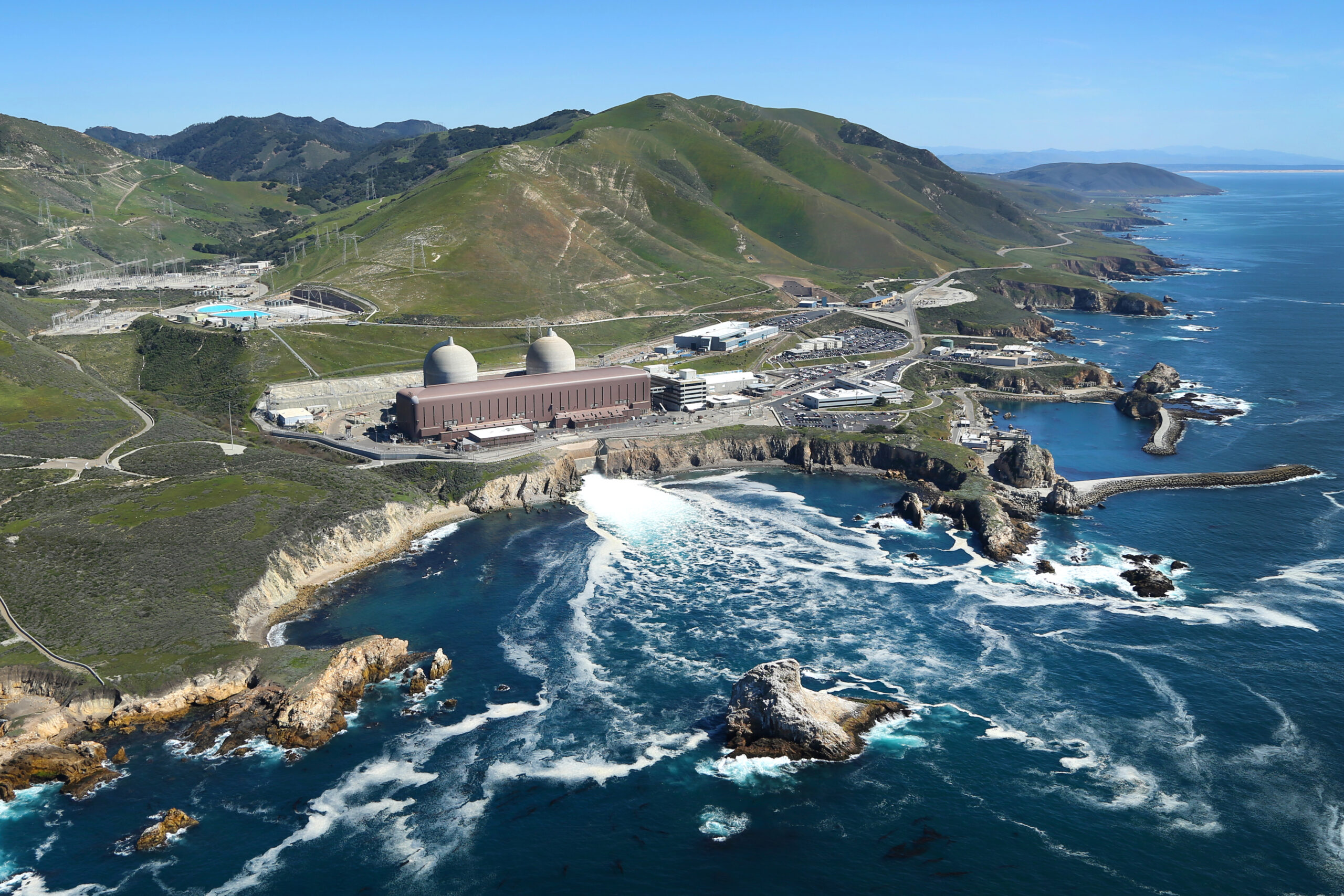
The Diablo Canyon nuclear power plant, perched on the Pacific Coast, supplies about 8% of California’s electricity. Through collaborations with Atomic Canyon and ORNL, Diablo Canyon is the first U.S. nuclear power plant to use generative AI. Credit: PG&E
Owned and operated by the Pacific Gas and Electric Company, or PG&E, Diablo Canyon supplies electricity to more than 4 million people in California. It provides about 8% of the state’s total energy.
After several decades of operation, Diablo Canyon was scheduled to be decommissioned in 2025, but in 2022, recognizing the growing demand for energy in California, state leaders reversed course and decided to extend operations to 2030.
“That meant we had to pivot into restarting a lot of things, including a massive application to the NRC that was about 3,000 pages,” said Maureen Zawalick, vice president at Diablo Canyon. “So, we were doing things in a very time-compressed manner — going through thousands and thousands of documents and records and information to meet all the requirements.”
Jordan Tyman, Diablo Canyon’s director overseeing the AI project, explained that submitting a license change is an extremely complicated process that can take days or weeks just to sift through documentation and industry guidelines before the writing process even begins.
“It’s very time consuming to search the volume of records we’ve amassed over the 50 years we have been doing licensing for Diablo Canyon,” Tyman said. “Having a way to incorporate all the lessons learned from previous submissions and rapidly find all the related documents to support the license amendment that’s easily digestible by the engineers would eliminate a big burden for our staff.”
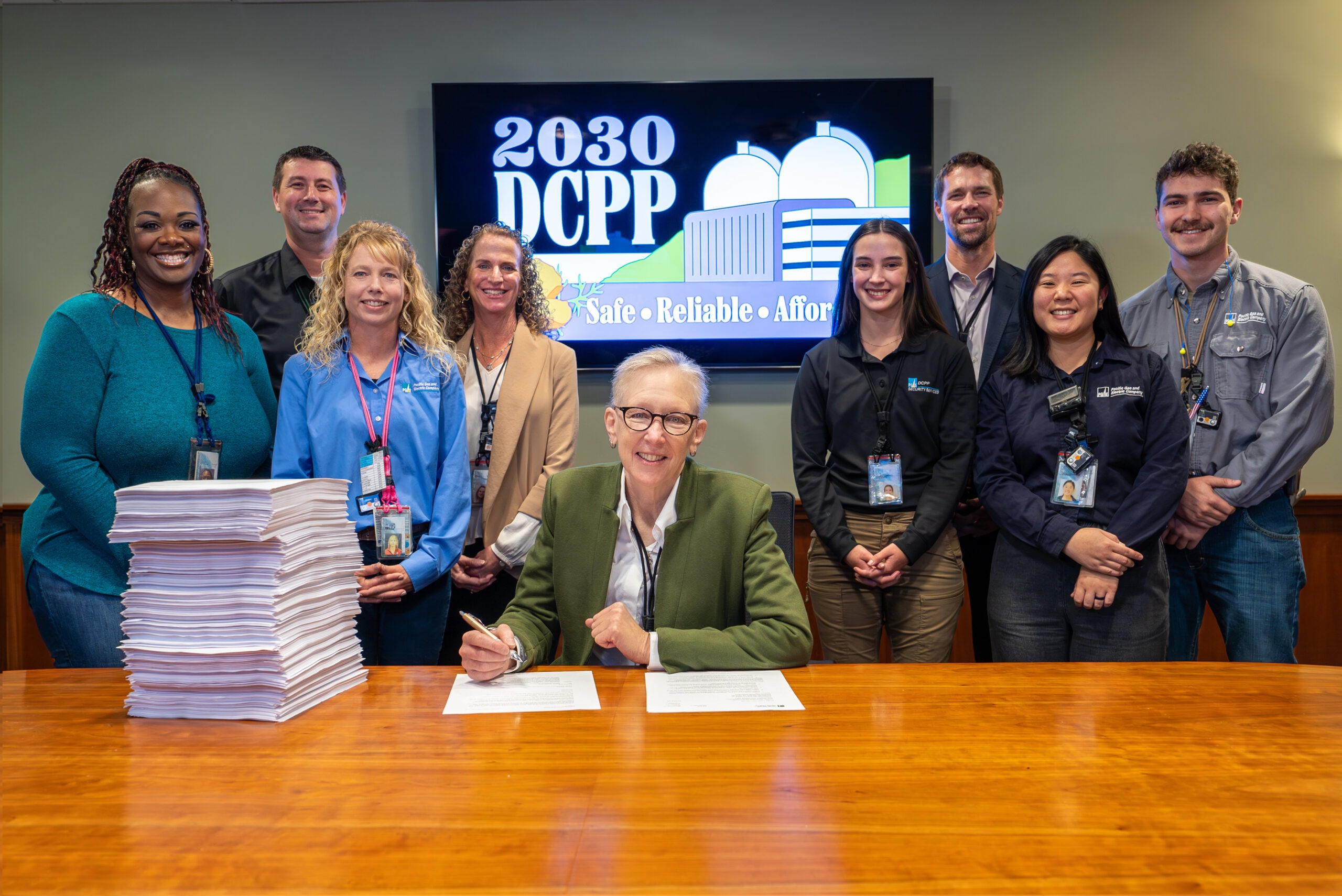
PG&E chief nuclear officer Paula Gerfen — along with (back-middle) Maureen Zawalick and (back-right) Diablo Canyon site vice president Adam Peck — signs the 3,000-page license renewal, extending Diablo Canyon operations until 2030. Atomic Canyon’s AI is designed to significantly reduce the resources spent searching documents and preparing reports. Credit: PG&E
Zawalick said she estimates staff probably spend around 15,000 hours a year just searching for documents. Diablo Canyon’s databases contain about 2 billion pages of documents, which require a significant amount of institutional knowledge to navigate. She pointed to a recent example in which an issue with a single valve triggered a 6-month investigation that pulled staff away from their regular duties.
“A hundred and eighty-one working days if anyone was counting,” said Erin Bowe, Diablo Canyon nuclear innovation supervisor.
“What we need is a natural language search tool, like asking Google to look up a specific component but without having to know a special number or a special indicator,” Bowe said. “We want a tool that we can use to say, ‘find valve X,’ and it will give us its entire history of that part and all the relevant information to the problem we’re trying to solve.”
AI has the potential to alleviate a lot of these necessary but labor-intensive requirements while also ensuring more accurate outcomes.
“However, you can’t just use any consumer AI model because, in the nuclear industry, precision matters and reliability is everything. You have to find the right documents and records. You have to do things accurately, and you have to do them repeatedly,” Lauderdale said.
The team tried using off-the-shelf AI tools, but every time they tested commercial AI models to search for specific nuclear documents and provide context, the models would inevitably struggle to properly work with nuclear jargon. Lauderdale said that’s because they weren’t familiar with the highly specific nuclear terminology. In some cases, commercial AI models have been known to experience hallucinations — instances in which the AI generates false or misleading information.
To solve this, the Atomic Canyon team decided to build their own AI model from scratch. But training AI models requires an enormous amount of computing power and the use of GPUs — and not just one GPU but lots of them. GPUs make training complex AI models faster because they excel at calculating large volumes of data with millions or billions of varying parameters.
“To ensure accuracy and reduce hallucinations, we needed a tremendous amount of data and the ability to run the data many times over to properly train the AI models,” Lauderdale said. “For us to start building AI that would work reliably, we needed a supercomputer.”
Learning the lingo
“ORNL is a world leader in nuclear engineering, AI and HPC, and we’ve worked with the NRC for more than 50 years on confirmatory analysis and licensing processes. We also own and develop the modeling and simulation tools used by the NRC,” said ORNL researcher Tom Evans, who specializes in developing approaches for nuclear-related applications using high-performance computing (HPC).
“Collaborating with Atomic Canyon uniquely positions us to address the national imperative for creating new AI tools that will greatly improve nuclear licensing processes,” Evans said.
Through the Oak Ridge Leadership Computing Facility’s (OLCF) Director’s Discretion allocation program, Atomic Canyon was awarded 20,000 GPU hours on the Frontier supercomputer, the world’s first exascale computer, which features more than 37,000 AMD Instinct™ MI250X GPUs.
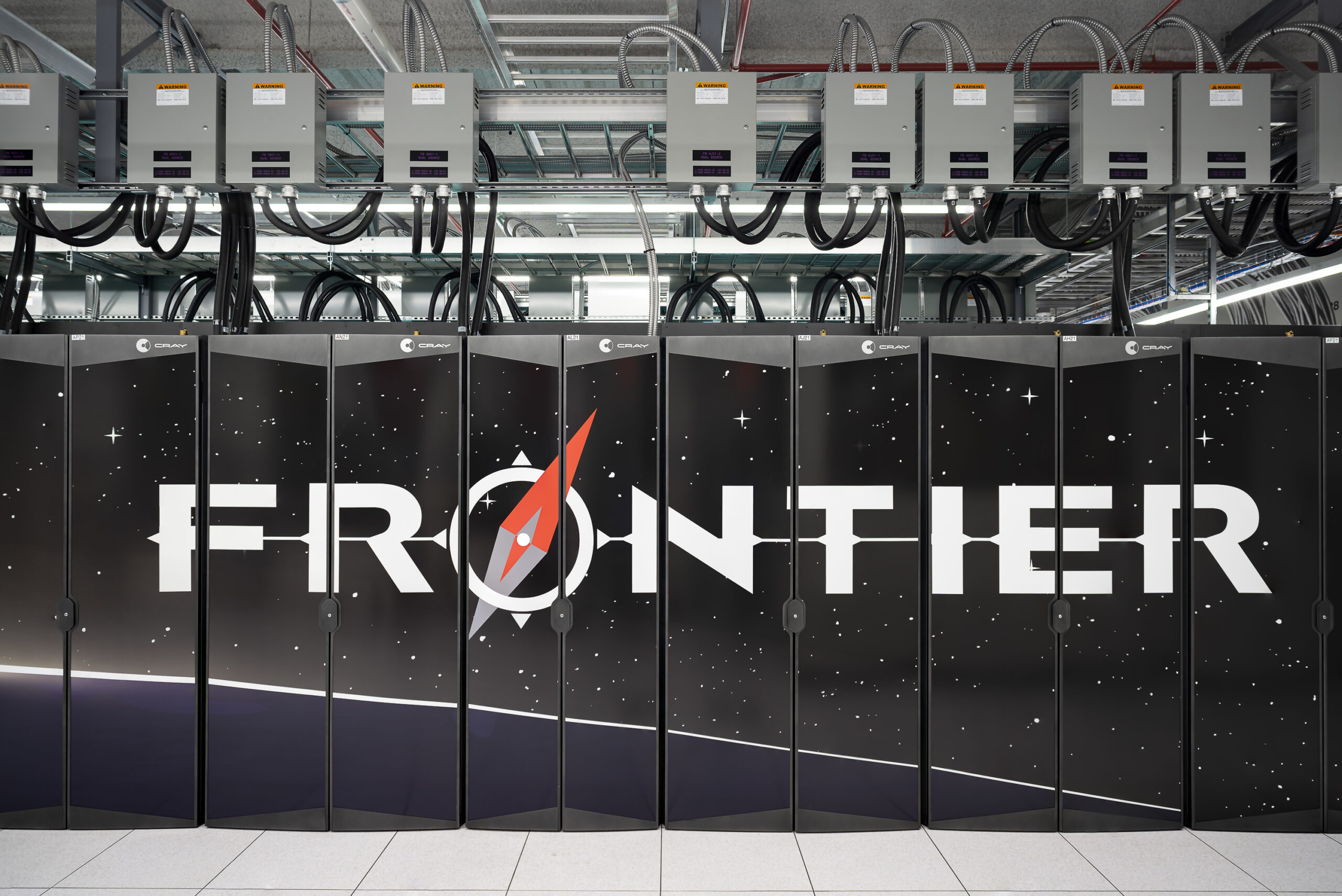
Frontier has a peak performance of 2 exaflops per second — meaning it can perform more than a billion-billion calculations per second — and is currently ranked No. 2 on the TOP500 list of the world’s most powerful supercomputers. Credit: Carlos Jones/ORNL, U.S. Dept. of Energy
The team used Frontier to help develop Atomic Canyon’s Neutron platform, an advanced AI solution that can accurately search and understand a wide range of complex nuclear data, from scanned documents and handwritten notes to technical reports and operational histories.
Atomic Canyon also deploys Neutron Enterprise, a version of Neutron that runs behind a company’s firewall to provide the highest level of cybersecurity and export control protocols to ensure the safety of business-sensitive data.
The Neutron platform is based on sentence embedding models, which are a specific type of AI that assigns numerical values to words. This approach enables the models to understand not just the meaning of nuclear-specific terminology and abbreviations but also their context within technical procedures and regulatory guidelines.
The sentence embedding models — nicknamed FERMI models — were trained with the NRC’s Agencywide Documents Access and Management System (ADAMS), which contains more than 3 million documents. ADAMS is the NRC’s official recordkeeping database and includes roughly 53 million pages of digital information, detailing the history of every nuclear reactor in the United States since 1980. Neutron’s AI smart-search capabilities will help users quickly find information within the ADAMS database and their own local document and records databases.
The number-crunching power of Frontier was necessary for running the data over and over again so that the FERMI models could recognize and rapidly retrieve the relevant information based on the user’s query.
“Sentence embedding models are primarily used for search and retrieval. They’re used for retrieving content rather than generating content, which is what LLMs do,” said Atomic Canyon head of engineering Richard Klafter. “Feeding content to an LLM requires retrieving the right content. The wrong content causes LLMs to hallucinate. So, our first step was to build a good retrieval model, which is our sentence embedding model that we trained on Frontier.”
In addition to enabling them to train a nuclear vocabulary model from scratch, Frontier’s computing power also allowed them to train a longer-context model.
“We wanted to double the input so the AI can handle larger chunks of information at once, but that requires several times the computing power,” Klafter said. “By making the AI better at understanding longer documents, we can cut down the amount of data we need to index by about half, which allows the system to run twice as fast.”
Next up for nuclear AI
Even in the project’s early stages, PG&E and Diablo Canyon staff are already seeing impressive results. The ability of Atomic Canyon’s tool to quickly search not only the plant’s own records for troubleshooting and problem-solving but also the entire history of the U.S. nuclear industry via the NRC ADAMS database is proving to be a game changer.
“Now we have this foundational search tool that’s built off of Diablo Canyon documentation after NRC ADAMS data,” Tyman said. “Next is how do we integrate that and apply it to other processes like developing procedures, training, doing assessments — things that really help our engineers focus on performing technical problem-solving and moving away from administrative tasks.”
“We’ve already seen increased productivity in certain areas using the new AI tools developed on Frontier,” Zawalick said. “The return on investment in terms of the time we spent working with Atomic Canyon and ORNL is very, very high.”
Atomic Canyon plans to update and build more versions of the FERMI models. At ORNL, Evans and his colleague Matthew Jessee, a senior R&D researcher, are currently exploring novel computing approaches to push the technology even further by combining the FERMI models with generative LLMs.
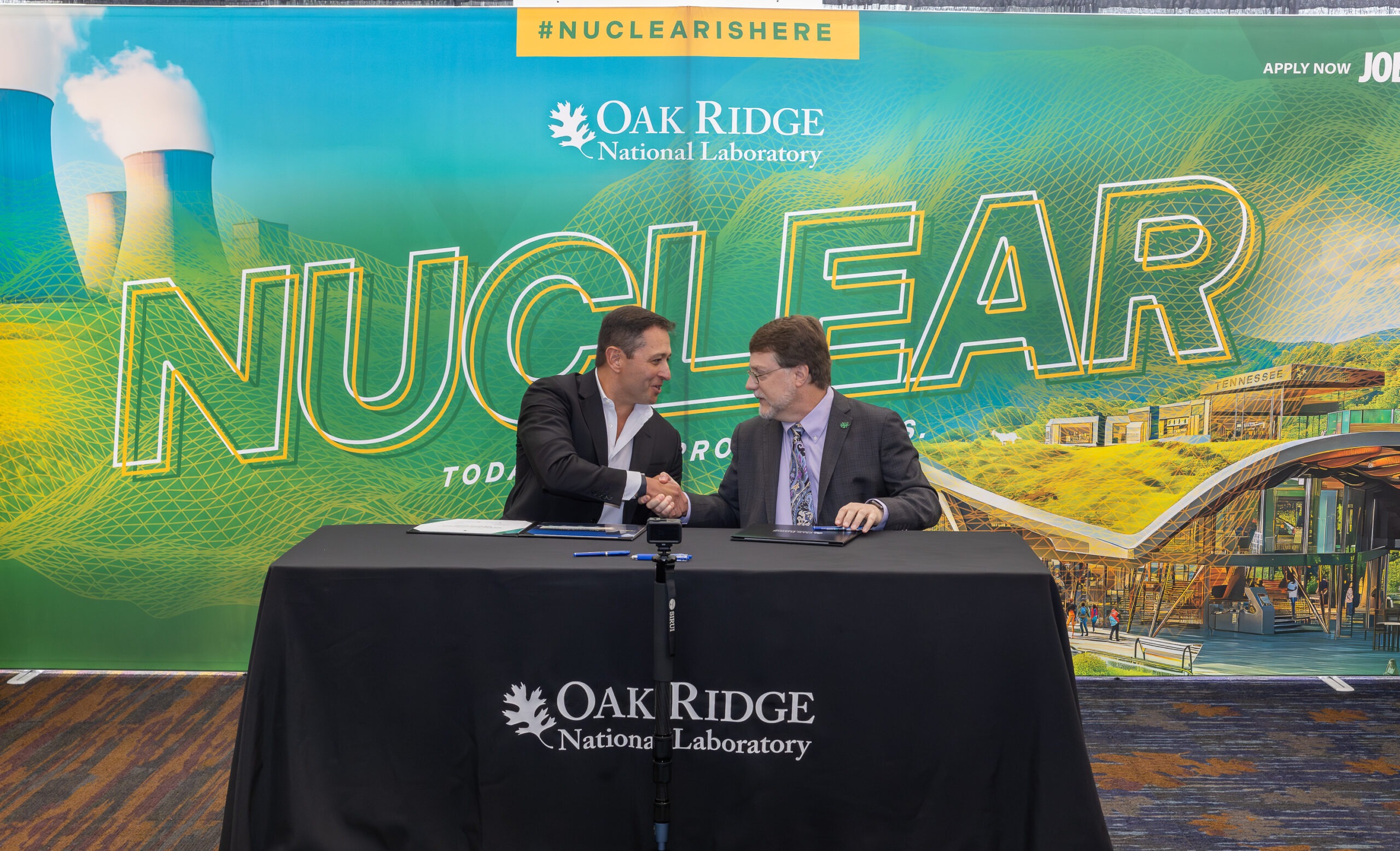
(Right) ORNL director Stephen Streiffer signs a memorandum of understanding with Atomic Canyon CEO Trey Lauderdale. Credit: Carlos Jones/ORNL, U.S. Dept. of Energy
In July, Atomic Canyon and ORNL signed a memorandum of understanding that outlines their shared intentions to further develop AI technology for the nuclear industry.
“We wanted FERMI models to be open-source so that anyone who wants to come and build nuclear-based AI can use the foundational models that we built with NRC data and DOE’s computing power,” Lauderdale said. “What we built at ORNL can be used to help the entire U.S. nuclear fleet.”
The Frontier supercomputer is managed by ORNL’s OLCF, a DOE Office of Science user facility.
ORNL is committed to supporting U.S. energy needs by pursuing strategic research that advances a wide variety of affordable, abundant and competitive nuclear technologies, and strengthens national security. The lab’s scientific expertise and world-class facilities are often the first step in advancing nuclear energy innovations.
UT-Battelle manages ORNL for DOE’s Office of Science, the single largest supporter of basic research in the physical sciences in the United States. DOE’s Office of Science is working to address some of the most pressing challenges of our time. For more information, visit energy.gov/science.